Estimated profit on a job
Estimated Profit, at the bottom of the Completion Detail tab, works out what the job actually made — the amount being charged, less what it cost you to do it.
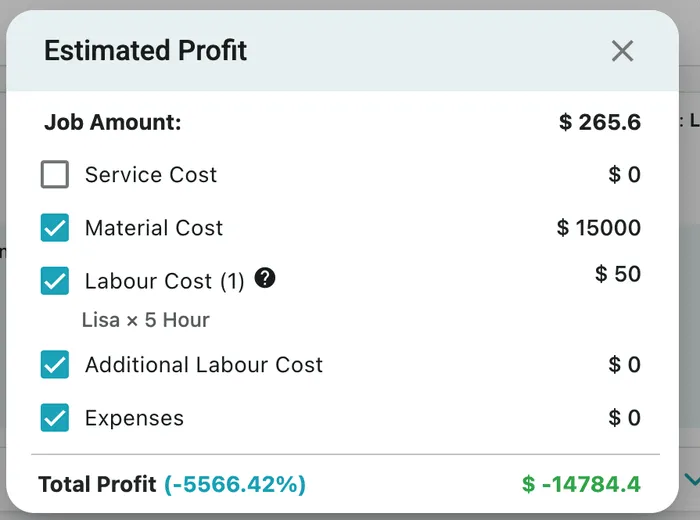
Completion Detail → Estimated Profit
How the figure is built
Section titled “How the figure is built”Job Amount at the top is what the job is worth — the total of its billable lines from the Item / Invoice tab.
Beneath it, each cost has its own line and its own tick box:
| Cost | Where it comes from |
|---|---|
| Service Cost | The cost of the services performed, as opposed to what they are sold for |
| Material Cost | What the parts and items used on the job cost you |
| Labour Cost | Worked out from the hours recorded against the job and the assigned users’ rates — shown as the person and their hours, so you can see how it was reached |
| Additional Labour Cost | Extra labour that is not on the standard calculation, such as an outside contractor |
| Expenses | Everything claimed on the job’s Expenses tab — fuel, tolls, parts bought on the way |
Total Profit is what is left, with the margin as a percentage.
Using the tick boxes
Section titled “Using the tick boxes”The tick boxes are the point of the window. Untick a cost and it drops out of the calculation, so you can see the job several ways without changing anything: the margin on labour alone, the margin before the parts, the margin once the drive is counted.
The default view — everything ticked — is the true cost. Turning things off is for understanding where the money went, not for producing a better-looking number.
Reading it honestly
Section titled “Reading it honestly”The figure is only as good as what has been recorded, and there are two common reasons it looks wrong:
Costs are in, income is not. A job that has consumed a €15,000 compressor but has not had that compressor put on it as a billable line will show a heavy loss. Check the Item / Invoice tab before believing the number.
The hours are wrong. Labour is calculated from the times on completion detail. A job someone forgot to close until the next morning carries hours nobody worked, and the profit falls accordingly. Correct the times first — see correcting times.
Read after both are right, the figure tells you which work is worth taking: which job types earn, which clients cost more to serve than they pay, and which repeat visits are quietly losing money.