Equipment leasing contracts
Equipment Leasing is the contract type for renting out your own equipment. It is the mirror image of a servicing contract: there, the client’s equipment is the subject of the work; here, your equipment is the source of the billing.
For the wider picture, start with how contracts work.
Because the rent is what drives the billing figure, the leasing step comes before billing terms in the wizard — you describe the assets first, and the recurring amount follows from them:

Add Contract wizard, Equipment Leasing type
Choosing how the rent is calculated
Section titled “Choosing how the rent is calculated”
Add Contract → Equipment Leasing step
Equipment-based gives every asset its own rate, and the invoice shows the breakup per asset.
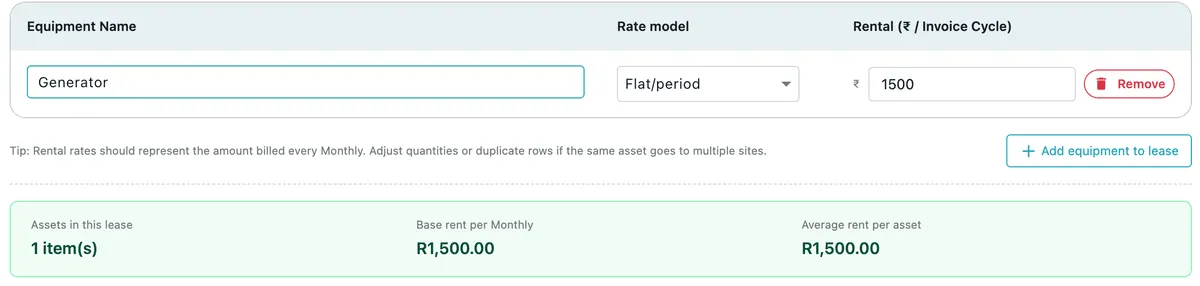
Add Contract → Equipment Leasing → Equipment-based
Each row carries a rate model, and this is the part worth getting right — it decides whether an asset is billed by the calendar or by how long it was actually out.
Flat / period is a fixed amount every invoice cycle. If the lease is invoiced monthly, a generator at 1,500 is 1,500 a month — whether it ran every day or sat idle the whole time. Every asset on a flat rate is charged at that same rhythm, and the summary strip keeps a running total of what the base rent per period comes to as you add rows.
Daily and hourly rates are usage-based, and they do not follow the invoice cycle. The charge comes from how long the asset was actually deployed:
Usage charge = (undeploy time − deploy time) × rateSo a machine on a daily rate that goes out on the 3rd and comes back on the 8th is billed for those five days, whatever the lease’s invoice frequency is. The deploy and undeploy timestamps are recorded by the fieldworker in the mobile app, which is what makes the calculation possible.
Because of this, a usage-based asset is only finally billed once it comes back. When a worker finishes a job the app asks whether the equipment is staying or returning: leaving it on site keeps it deployed and the meter running, while taking it back undeploys it and closes off that usage period for invoicing.
Custom amount replaces the per-asset rates with a single agreed figure for everything together.
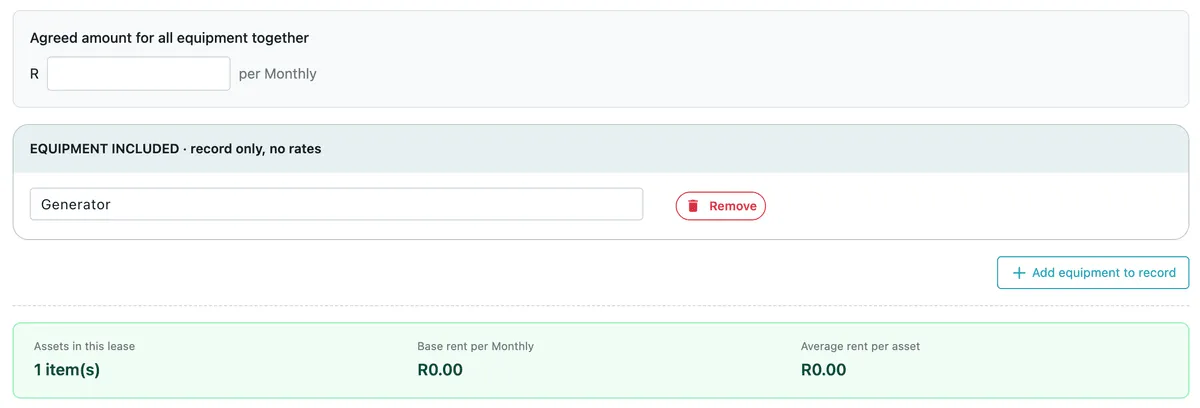
Add Contract → Equipment Leasing → Custom amount
The equipment list is still kept, but marked record only, no rates — it documents what was handed over, while the invoice simply shows the one agreed amount.
When the lease was sold as a package
Section titled “When the lease was sold as a package”A leasing contract can be built as a predrafted contract, quoted as a package, and converted when the client approves. The rent then has two possible sources — the figure in the blueprint, and the figure on the quote — and which one the contract ends up with depends on the billing approach you chose in the blueprint.
Custom amount: the quote wins, always. Predraft the lease at 5,000 a period, quote it, drop the package to 4,000 on the quotation, and the contract converts with 4,000 in Custom amount. The blueprint’s figure is overwritten. One agreed amount on the quote has exactly one place to go, so it goes there.
Equipment-based with one asset: the quote wins too. There is only one rental to write, so the quoted figure overwrites that asset’s rate the same way.
Equipment-based with several assets: the quote is ignored. One amount cannot be divided across three machines — the app has no basis on which to split it — so the conversion stops and tells you so:
Quoted amount can’t be applied to this lease
This lease is billed per asset and has multiple assets on it, so one quoted amount can’t be divided between them. The contract will be created with the rental rates from the predrafted contract, not the amount on the quotation.
To use the quoted amount, set the rates yourself on the Equipment Leasing step after converting.
The contract is then right by the blueprint and does not match what you quoted, which is the one case where the two disagree. Nothing is broken — the app simply has no way to work out which machine should carry which share of a single figure, so it leaves the rates it can defend and hands the decision to you.
So if you expect to negotiate the price of a leased package, build the blueprint on Custom amount. A negotiated figure then lands where you meant it to, whatever the lease holds. Equipment-based blueprints are for leases whose per-asset rates are the agreement — quote them at the rates they carry, and if a multi-asset lease has to be discounted, change the rates on the contract after converting rather than on the quote.
The invoice rhythm
Section titled “The invoice rhythm”
Add Contract → Equipment Leasing → Payment Terms
The Lease Invoice Frequency sets how often the rent is billed, and it is the period that flat per-asset rates are quoted against. Usage-based rates ignore it, since their charge comes from the deploy-to-undeploy span instead.
Mode of Payment records how the client pays the rent — cash, cheque, card, direct deposit, or whichever modes you have added under invoice and accounts settings, the one list every module draws on.
Neither is locked once the contract is running. Edit Contract reopens the wizard with everything filled in, so come back to this step and change the frequency or the payment mode whenever the arrangement changes. See the contract lifecycle.
Servicing the assets you lease
Section titled “Servicing the assets you lease”Renting an asset out does not mean you stop looking after it. A leasing contract can carry work patterns just like a servicing one — set the pattern up with the service you want performed, and every job it creates will do that work on the leased equipment. You can also raise a one-off job against the contract whenever something needs attention between scheduled visits.
This is how a lease stays maintained: the rent is handled by the leasing terms, while routine servicing runs off the work pattern, on the same contract.
Rate cards continue to price anything else the work consumes — fuel, replacement parts, damage, call-outs.
The assets themselves live in my equipment, and what a deployment does to a unit’s record is covered in equipment on contracts.